


Free Shipping apply to all orders over ₹999/-

Guaranteed Money Back in 7 days return.

10 Day Returns in case u change your mind.

Original price was: ₹800.₹299Current price is: ₹299.


+91 7238008852
GRAB! 5% Use Code - "5CFKGMZM"
ALERT ! New Prices Affective From April 2026
Partial COD Payment Now Available.
B2B Billing Available - Free Shipping Above 999/- on all orders.
GRAB! 5% Use Code - "5CFKGMZM"
ALERT ! New Prices Affective From April 2026
Partial COD Payment Now Available.
B2B Billing Available - Free Shipping Above 999/- on all orders.


₹800 Original price was: ₹800.₹299Current price is: ₹299.
FREE DELIVERY★
Feel free to Get in touch
Safe payment on our website
Free Shipping apply to all orders over ₹999/-
Guaranteed Money Back in 7 days return.
10 Day Returns in case u change your mind.
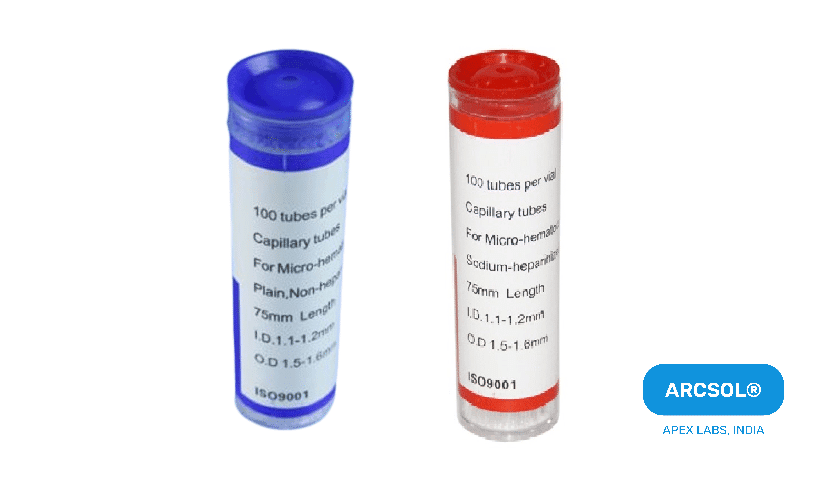
Precision-engineered Glass Capillary Tubes are essential for micro-volume liquid handling, melting point determinations, and specialized microbiology assays. These tubes are crafted from high-quality borosilicate glass, ensuring excellent chemical resistance and thermal stability.
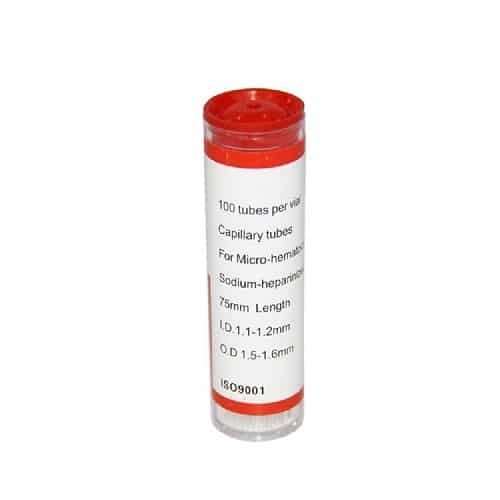
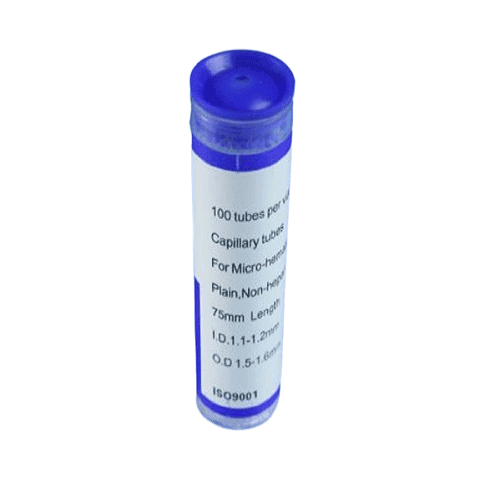
They are typically available in two varieties: Heparinized (red coded) to prevent blood clotting during collection, and Non-Heparinized (blue coded) for general laboratory use.
High Precision: Uniform bore diameter ensures accurate capillary action and consistent volume collection.
Borosilicate 3.3 Glass: Superior clarity and resistance to thermal shock and chemical corrosion.
Color-Coded Ends: Easy identification between treated (Heparin) and untreated tubes.
Fire-Polished Ends: Smooth edges prevent damage to samples and reduce the risk of injury during handling.
Standard Dimensions: Usually 75mm in length with an internal diameter of approximately 1.1mm to 1.2mm.
| Feature | Details |
| Material | Borosilicate Glass (Type 1) |
| Length | 75 mm (Standard) |
| Inside Diameter | 1.1 mm – 1.2 mm |
| Outside Diameter | 1.5 mm – 1.6 mm |
| Packaging | Vials of 100 or 500 pieces |
| Sterility | Available in Sterile or Non-Sterile |
Hematology: Micro-hematocrit determinations and blood gas analysis.
Microbiology: Precise transfer of minute microbial cultures or reagents.
Chemistry: Melting point capillary tubes for identifying crystalline substances.
Sample Collection: Harvesting small volumes of liquid via capillary action without the need for a pump.
Only logged in customers who have purchased this product may leave a review.
₹800 Original price was: ₹800.₹299Current price is: ₹299.

Reviews
There are no reviews yet.